Who Is Bavaria in Revolt Agains
| Free Land of Bavaria Freistaat Bayern (High german) | |
|---|---|
| Land | |
| Flag Coat of arms | |
| Anthem: Bayernhymne (German language) "Hymn of Bavaria" | |
 | |
| Coordinates: 49°04′43″N 11°23′08″Eastward / 49.07861°N eleven.38556°E / 49.07861; 11.38556 Coordinates: 49°04′43″N 11°23′08″East / 49.07861°N 11.38556°E / 49.07861; 11.38556 | |
| State | Germany |
| Capital | Munich |
| Regime | |
| • Body | Landtag of Bavaria |
| • Minister-President | Markus Söder (CSU) |
| • Governing parties | CSU / FW |
| • Bundesrat votes | 6 (of 69) |
| Surface area | |
| • Total | lxx,550.19 km2 (27,239.58 sq mi) |
| Population (2019-12-31) | |
| • Full | 13,124,737 |
| • Density | 186/km2 (480/sq mi) |
| Demonym(south) | Bavarians |
| Time zone | UTC+i (CET) |
| • Summer (DST) | UTC+2 (CEST) |
| ISO 3166 code | DE-BY |
| GRP (nominal) | €633 billion (2019)[2] |
| GRP per capita | €48,000 (2019) |
| NUTS Region | DE2 |
| HDI (2018) | 0.956[3] very high · 5th of 16 |
| Website | https://www.bayern.de |


Bavaria (; German: Bayern, pronounced [ˈbaɪ̯ɐn] (  mind )), officially the Free State of Bavaria (German language: Freistaat Bayern, [ˈfʁaɪʃtaːt ˈbaɪɐn] ( listen ); Bavarian: Freistoot Bayern), is a state in the south-east of Germany. With an area of 70,550.19 km2 (27,239.58 sq mi), Bavaria is the largest German language state by land area, comprising roughly a fifth of the total land area of Germany. With over 13 million inhabitants, information technology is second in population only to North Rhine-Westphalia, but due to its large size its population density is beneath the German average. Bavaria'south principal cities are Munich (its capital and largest city and also the third largest city in Germany),[iv] Nuremberg, and Augsburg.
The history of Bavaria includes its primeval settlement by Iron Age Celtic tribes, followed past the conquests of the Roman Empire in the 1st century BC, when the territory was incorporated into the provinces of Raetia and Noricum. Information technology became the Duchy of Bavaria (a stalk duchy) in the 6th century Advertisement post-obit the collapse of the Western Roman Empire. It was later incorporated into the Holy Roman Empire, became an independent kingdom after 1806, joined the Prussian-led German Empire in 1871 while retaining its title of kingdom, and finally became a state of the Federal Republic of Federal republic of germany in 1949.[5]
Bavaria has a unique culture, largely because of the land's large Catholic plurality and conservative traditions.[6] Bavarians have traditionally been proud of their culture, which includes a language, cuisine, compages, festivals such every bit Oktoberfest and elements of Alpine symbolism.[7] The state as well has the second largest economy amid the German states by GDP figures, giving it a status as a rather wealthy German language region.[8]
Contemporary Bavaria as well includes parts of the historical regions of Franconia and Swabia.
History [edit]

Antiquity [edit]
The Bavarians emerged in a region n of the Alps, previously inhabited past Celts, which had been function of the Roman provinces of Raetia and Noricum.
The Bavarians spoke a Germanic dialect which adult into Old High German during the early Heart Ages, just, different other Germanic groups, they probably did not migrate from elsewhere during the flow of Western Roman plummet.
Rather, they seem to take coalesced out of other groups left behind by the Roman withdrawal late in the 5th century. These peoples may have included the Celtic Boii, some remaining Romans, Marcomanni, Allemanni, Quadi, Thuringians, Goths, Scirians, Rugians, Heruli. The name "Bavarian" ("Baiuvarii") means "Men of Baia" which may indicate Bohemia, the homeland of the Celtic Boii and later of the Marcomanni. They first appear in written sources circa 520.
A 17th century Jewish chronicler David Solomon Ganz, citing Cyriacus Spangenberg, claimed that the diocese was named after an ancient Maverick king, Boiia, in the 14th century BC.[9]
Center Ages [edit]
From about 554 to 788, the house of Agilolfing ruled the Duchy of Bavaria, ending with Tassilo Iii who was deposed by Charlemagne.[10]
3 early on dukes are named in Frankish sources: Garibald I may take been appointed to the office by the Merovingian kings and married the Lombard princess Walderada when the church forbade her to King Chlothar I in 555. Their girl, Theodelinde, became Queen of the Lombards in northern Italy and Garibald was forced to flee to her when he fell out with his Frankish overlords.
Garibald's successor, Tassilo I, tried unsuccessfully to hold the eastern frontier against the expansion of Slavs and Avars around 600. Tassilo's son Garibald II seems to have achieved a residue of power betwixt 610 and 616.[11]
After Garibald II, trivial is known of the Bavarians until Duke Theodo I, whose reign may have begun as early as 680. From 696 onward, he invited churchmen from the west to organize churches and strengthen Christianity in his duchy. (It is unclear what Bavarian religious life consisted of earlier this time.)
His son, Theudebert, led a decisive Bavarian campaign to arbitrate in a succession dispute in the Lombard Kingdom in 714, and married his sis Guntrud to the Lombard Rex Liutprand. At Theodo's expiry the duchy was divided among his sons, only reunited nether his grandson Hugbert.
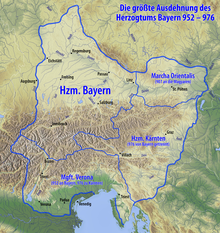
Bavaria in the 10th century
At Hugbert's expiry (735) the duchy passed to a distant relative named Odilo, from neighboring Alemannia (modern southwest Germany and northern Switzerland). Odilo issued a law lawmaking for Bavaria, completed the process of church system in partnership with St. Boniface (739), and tried to intervene in Frankish succession disputes past fighting for the claims of the Carolingian Grifo. He was defeated near Augsburg in 743 just continued to rule until his decease in 748.[12] [13]
Saint Boniface completed the people's conversion to Christianity in the early 8th century. Tassilo Iii (b. 741 – d. after 796) succeeded his father at the age of eight after an unsuccessful attempt by Grifo to rule Bavaria. He initially ruled under Frankish oversight merely began to function independently from 763 onward. He was particularly noted for founding new monasteries and for expanding eastwards, fighting Slavs in the eastern Alps and along the Danube and colonizing these lands.
After 781, yet, his cousin Charlemagne began to pressure Tassilo to submit and finally deposed him in 788. The deposition was not entirely legitimate.
Dissenters attempted a insurrection against Charlemagne at Tassilo's old capital letter of Regensburg in 792, led past his ain son Pépin the Hunchback. The rex had to drag Tassilo out of imprisonment to formally renounce his rights and titles at the Assembly of Frankfurt in 794. This is the concluding appearance of Tassilo in the sources, and he probably died a monk. As all of his family were too forced into monasteries, this was the end of the Agilolfing dynasty.

The Bavarian duchies after the sectionalisation of 1392
For the side by side 400 years numerous families held the duchy, rarely for more than than 3 generations. With the defection of duke Henry the Quarrelsome in 976, Bavaria lost large territories in the south and due south east.
The territory of Ostarrichi was elevated to a duchy in its own correct and given to the Babenberger family. This event marks the founding of Austria.
The concluding, and one of the most important, of the dukes of Bavaria was Henry the Lion of the house of Welf, founder of Munich, and de facto the second most powerful man in the empire as the ruler of 2 duchies. When in 1180, Henry the King of beasts was deposed as Duke of Saxony and Bavaria by his cousin, Frederick I, Holy Roman Emperor (a.thou.a. "Barbarossa" for his crimson bristles), Bavaria was awarded as fief to the Wittelsbach family, counts palatinate of Schyren ("Scheyern" in modern German). They ruled for 738 years, from 1180 to 1918. The Electorate of the Palatinate by Rhine (Kurpfalz in German language) was too acquired by the Business firm of Wittelsbach in 1214, which they would subsequently concur for six centuries.[14]
The first of several divisions of the duchy of Bavaria occurred in 1255. With the extinction of the Hohenstaufen in 1268, Swabian territories were caused past the Wittelsbach dukes. Emperor Louis the Bavarian acquired Brandenburg, Tyrol, Holland and Hainaut for his Business firm just released the Upper Palatinate for the Palatinate branch of the Wittelsbach in 1329.
In the 14th and 15th centuries, upper and lower Bavaria were repeatedly subdivided. Four Duchies existed after the partition of 1392: Bavaria-Straubing, Bavaria-Landshut, Bavaria-Ingolstadt and Bavaria-Munich. In 1506 with the Landshut State of war of Succession, the other parts of Bavaria were reunited, and Munich became the sole uppercase. The country became a heart of the Jesuit-inspired Counter- Reformation.

Bavarian herald Joerg Rugenn wearing a tabard of the artillery around 1510
Electorate of Bavaria [edit]
In 1623 the Bavarian knuckles replaced his relative of the Palatinate branch, the Electorate of the Palatinate in the early days of the Xxx Years' State of war and acquired the powerful prince-electoral dignity in the Holy Roman Empire, determining its Emperor thence forward, likewise every bit special legal condition under the empire's laws.
During the early on and mid-18th century the ambitions of the Bavarian prince electors led to several wars with Austria also as occupations by Austria (War of the Spanish Succession, War of the Austrian Succession with the election of a Wittelsbach emperor instead of a Habsburg).
From 1777 onward, and after the younger Bavarian branch of the family unit had died out with elector Max III Joseph, Bavaria and the Electorate of the Palatinate were governed once once more in personal spousal relationship, now by the Palatinian lines.
The new state also comprised the Duchies of Jülich and Berg as these on their part were in personal spousal relationship with the Palatinate.
Kingdom of Bavaria [edit]
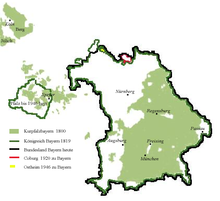
Bavaria in the 19th century and across
When Napoleon abolished the Holy Roman Empire, Bavaria became - by grace of Napoleon - a kingdom in 1806 due, in part, to the Confederation of the Rhine.[15]
Its area doubled after the Duchy of Jülich was ceded to France, as the Electoral Palatinate was divided between France and the Thousand Duchy of Baden. The Duchy of Berg was given to Jerome Bonaparte. Tyrol and Salzburg were temporarily reunited with Bavaria but finally ceded to Austria past the Congress of Vienna.
In return Bavaria was allowed to annex the modern-day region of Palatinate to the west of the Rhine and Franconia in 1815. Betwixt 1799 and 1817, the leading government minister, Count Montgelas, followed a strict policy of modernisation copying Napoleonic France; he laid the foundations of centralized administrative structures that survived the monarchy and, in part, have retained core validity through the 20st century.
In May 1808, a offset constitution was passed by Maximilian I,[xvi] being modernized in 1818. This 2d version established a bicameral Parliament with a Firm of Lords (Kammer der Reichsräte) and a House of Commons (Kammer der Abgeordneten). That constitution was followed until the collapse of the monarchy at the end of World War I.
Subsequently the rise of Prussia to power in the early 18th century, Bavaria preserved its independence by playing off the rivalry of Prussia and Republic of austria. Centrolineal to Austria, information technology was defeated along with Austria in the 1866 Austro-Prussian War and was not incorporated into the Due north High german Confederation of 1867, but the question of German unity was all the same alive. When France declared war on Prussia in 1870, all the s German states (Baden, Württemberg, Hessen-Darmstadt and Bavaria) bated from Austria, joined the Prussian forces and ultimately joined the Federation, which was renamed Deutsches Reich (German language Empire) in 1871.
Bavaria continued formally every bit a monarchy, and it had some special rights within the federation (such as an army, railways, postal service and a diplomatic torso of its own) only the diplomatic body were later undone by Wilhelm II who declared them illegal and got rid of the diplomatic service.[ citation needed ]
Role of the High german Empire [edit]
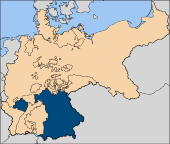
When Bavaria became part of the newly formed German Empire, this action was considered controversial by Bavarian nationalists who had wanted to retain independence from the rest of Germany, as had Austria.
Equally Bavaria had a heavily Catholic bulk population, many people resented being ruled by the mostly Protestant northerners of Prussia. As a direct result of the Bavarian-Prussian feud, political parties formed to encourage Bavaria to break abroad and regain its independence.[17]
In the early 20th century, Wassily Kandinsky, Paul Klee, Henrik Ibsen, and other artists were drawn to Bavaria, especially to the Schwabing district of Munich, a middle of international creative activity. This surface area was devastated by bombing and invasion during World War II.[ citation needed ]
Free State of Bavaria [edit]

A memorial to soldiers who died in the 2 World Wars in Dietelskirchen (Kröning), Bavaria
Costless Country has been an adopted designation after the abolition of monarchy in the aftermath of Globe War I in several German states.
On 12 November 1918, Ludwig 3 signed a document, the Anif declaration, releasing both civil and military officers from their oaths; the newly formed republican authorities, or "People's Country" of Socialist premier Kurt Eisner,[18] interpreted this every bit an abdication. To date, even so, no fellow member of the House of Wittelsbach has always formally declared renunciation of the throne.[19]
On the other hand, none has ever since officially called upon their Bavarian or Stuart claims. Family unit members are active in cultural and social life, including the head of the firm, Franz, Knuckles of Bavaria. They stride back from whatever announcements on public affairs, showing approving or disapproval solely by Franz'south presence or absence.
Eisner was assassinated in February 1919, ultimately leading to a Communist revolt and the short-lived Bavarian Soviet Commonwealth beingness proclaimed six Apr 1919. After violent suppression by elements of the German Ground forces and notably the Freikorps, the Bavarian Soviet Republic fell in May 1919. The Bamberg Constitution ( Bamberger Verfassung ) was enacted on 12 or 14 August 1919 and came into forcefulness on 15 September 1919 creating the Gratuitous State of Bavaria within the Weimar Republic.
Extremist action further increased, notably the 1923 Beer Hall Coup d'état led by the National Socialists, and Munich and Nuremberg became seen equally Nazi strongholds during the Weimar Republic and Nazi dictatorship. However, in the crucial German language federal election, March 1933, the Nazis received less than 50% of the votes cast in Bavaria.
As a manufacturing centre, Munich was heavily bombed during World War II and was occupied by U.S. troops, becoming a major part of the American Zone of Allied-occupied Germany (1945–47) then of "Bizonia".
The Rhenish Palatinate was detached from Bavaria in 1946 and made part of the new land Rhineland-Palatinate. During the Cold War, Bavaria was part of West Deutschland. In 1949, the Free Country of Bavaria chose not to sign the Founding Treaty (Gründungsvertrag) for the formation of the Federal Democracy of Germany, opposing the division of Germany into two countries afterward World War II.
The Bavarian Parliament did not sign the Basic Law of Germany, mainly because information technology was seen every bit not granting sufficient powers to the private Länder (states), but at the same time decided that information technology would still come into force in Bavaria if two-thirds of the other Länder ratified information technology. All of the other Länder ratified it, however, so it became law.[20]
Bavarian identity [edit]

Bavarians have frequently emphasized a dissever national identity and considered themselves as "Bavarians" first, "Germans" 2d.[21]
In the 19th-century sense, an independent Bavarian State only existed from 1806-71. This feeling started to come up about more strongly amid Bavarians when the Kingdom of Bavaria was forced by Bismarck to bring together the Protestant Prussian-dominated German Empire in 1871, while the Bavarian nationalists wanted to keep Bavaria as Catholic and an contained state. Aside from the minority Bavaria Party, most Bavarians now take Bavaria is office of Federal republic of germany.[22]
Another consideration is that Bavarians foster different cultural identities: Franconia in the n, speaking East Franconian German; Bavarian Swabia in the southward due west, speaking Swabian German; and Altbayern (so-called "Onetime Bavaria", the regions forming the "historic", pentagon-shaped Bavaria before the acquisitions through the Vienna Congress, at present the districts of the Upper Palatinate, Lower and Upper Bavaria) speaking Austro-Bavarian.[ citation needed ]
In Munich, the Old Bavarian dialect was widely spread, only nowadays Loftier German is predominantly spoken there. Moreover, by the expulsion of German speakers from Eastern Europe, Bavaria has received a large population that was not traditionally Bavarian. In particular, the Sudeten Germans, expelled from neighboring Czechoslovakia, have been deemed to accept become the "fourth tribe" of Bavarians.[ citation needed ]
Flags and coat of arms [edit]
Flags [edit]
Uniquely amidst German states, Bavaria has ii official flags of equal status, one with a white and blue stripe, the other with white and blue lozenges. Either may exist used by civilians and government offices, who are free to choose betwixt them.[23] Unofficial versions of the flag, especially a lozenge style with coat of arms, are sometimes used by civilians.
Coat of arms [edit]
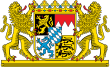
The modern coat of arms of Bavaria was designed past Eduard Ege in 1946, following heraldic traditions.
- The Golden Lion: At the dexter chief, sable, a panthera leo rampant Or, armed and langued gules. This represents the administrative region of Upper Palatinate.
- The "Franconian Rake": At the sinister chief, per fess dancetty, gules, and argent. This represents the administrative regions of Upper, Middle and Lower Franconia.
- The Bluish "Pantier" (mythical creature from French heraldry, sporting a flame instead of a tongue): At the dexter base, argent, a Pantier rampant azure, armed Or and langued gules. This represents the regions of Lower and Upper Bavaria.
- The Three Lions: At the sinister base of operations, Or, 3 lions passant guardant sable, armed and langued gules. This represents Swabia.
- The White-And-Blue inescutcheon: The inescutcheon of white and blueish fusils askance was originally the glaze of arms of the Counts of Bogen, adopted in 1247 by the House of Wittelsbach. The white-and-blueish fusils are indisputably the emblem of Bavaria and these arms today symbolize Bavaria as a whole. Forth with the People's Crown, it is officially used as the Minor Glaze of Arms.
- The People's Crown (Volkskrone): The glaze of arms is surmounted by a crown with a aureate band inset with precious stones and decorated with five ornamental leaves. This crown first appeared in the glaze of arms to symbolize sovereignty of the people after the majestic crown was eschewed in 1923.
Geography [edit]

Bavaria shares international borders with Austria (Salzburg, Tyrol, Upper Austria and Vorarlberg) and the Czech Republic (Karlovy Vary, Plzeň and South Bohemian Regions), likewise as with Switzerland (beyond Lake Constance to the Canton of St. Gallen).
All of these countries are function of the Schengen Area, and then the border is completely open.
Neighboring states inside Federal republic of germany are Baden-Württemberg, Hesse, Thuringia, and Saxony. Two major rivers flow through the state: the Danube (Donau) and the Main. The Bavarian Alps define the border with Austria (including the Austrian federal-states of Vorarlberg, Tyrol and Salzburg), and inside the range is the highest superlative in Germany: the Zugspitze.
The Bavarian Forest and the Bohemian Forest grade the vast majority of the frontier with the Czechia and Bohemia.
The major cities in Bavaria are Munich (München), Nuremberg (Nürnberg), Augsburg, Regensburg, Würzburg, Ingolstadt, Fürth, and Erlangen.
The geographic center of the European Union is located in the northwestern corner of Bavaria.
Climate [edit]
At lower elevations the climate is classified according to Köppen's guide every bit "Cfb" or "Dfb" at lower altitudes, then at higher altitudes the climate becomes "Dfc" and "ET".
The summer months have been getting hotter in recent years.[24] For instance, June 2019 was the warmest June in Bavaria since conditions observations take been recorded[24] and the wintertime 2019/2020 was iii degrees Celsius warmer than the average temperature for many years all over Bavaria. On 20 December 2019 a record temperature of 20.two °C (68.4 °F) was recorded in Piding.[25] In general winter months are seeing more precipitation which is taking the grade of rain more ofttimes than that of snow compared to the past.[24] Farthermost weather like the 2013 European floods or the 2019 European heavy snowfalls is occurring more and more often. One outcome of the standing warming is the melting of almost all Bavarian Tall glaciers: Of the five glaciers of Bavaria only the Höllentalferner is predicted to be over a longer time perspective. The Südliche Schneeferner has almost vanished since the 1980s.[24]
Administrative divisions [edit]
Administrative regions [edit]
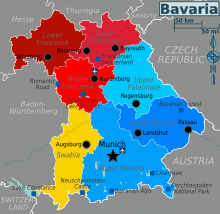
Administrative regions ( Regierungsbezirke and Bezirke ) of Bavaria
Bavaria is divided into seven administrative regions called Regierungsbezirke (singular Regierungsbezirk ). For every Administrative regions be a state agency called Bezirksregierung (district government).
- Altbayern:
- Upper Palatinate (High german: Oberpfalz )
- Upper Bavaria ( Oberbayern )
- Lower Bavaria ( Niederbayern )
- Franconia:
- Upper Franconia ( Oberfranken )
- Middle Franconia ( Mittelfranken )
- Lower Franconia ( Unterfranken )
- Swabia:
- Swabia ( Schwaben )
Bezirke [edit]
Bezirke (districts) are the 3rd communal layer in Bavaria; the others are the Landkreise and the Gemeinden or Städte . The Bezirke in Bavaria are territorially identical with the Regierungsbezirke , but they are self-governing regional corporation, having their ain parliaments. In the other larger states of Deutschland, at that place are only Regierungsbezirke as authoritative divisions and no self-governing entities at the level of the Regierungsbezirke equally the Bezirke in Bavaria.
Population and area [edit]
| Bezirk | Coat of arms | Capital | Population (2019)[26] | Area (km2) | No. municipalities | |||
|---|---|---|---|---|---|---|---|---|
| Lower Bavaria |  | Landshut | 1,244,169 | 9.48% | 10,330 | 14.6% | 258 | 12.5% |
| Lower Franconia |  | Würzburg | one,317,619 | 10.46% | viii,531 | 12.1% | 308 | xv.0% |
| Upper Franconia |  | Bayreuth | ane,065,371 | viii.49% | 7,231 | 10.ii% | 214 | 10.4% |
| Middle Franconia |  | Ansbach | 1,775,169 | 13.65% | 7,245 | 10.3% | 210 | x.2% |
| Upper Palatinate |  | Regensburg | ane,112,102 | 8.sixty% | 9,691 | 13.7% | 226 | xi.0% |
| Swabia |  | Augsburg | i,899,442 | 14.21% | 9,992 | 14.2% | 340 | 16.5% |
| Upper Bavaria |  | Munich | four,710,865 | 35.12% | 17,530 | 24.8% | 500 | 24.iii% |
| Total | 13,124,737 | 100.0% | lxx,549 | 100.0% | two,056 | 100.0% | ||
Districts [edit]
The 2nd communal layer is made upwardly of 71 rural districts (called Landkreise , atypical Landkreis ) that are comparable to counties, as well as the 25 independent cities ( Kreisfreie Städte , atypical Kreisfreie Stadt ), both of which share the aforementioned administrative responsibilities.
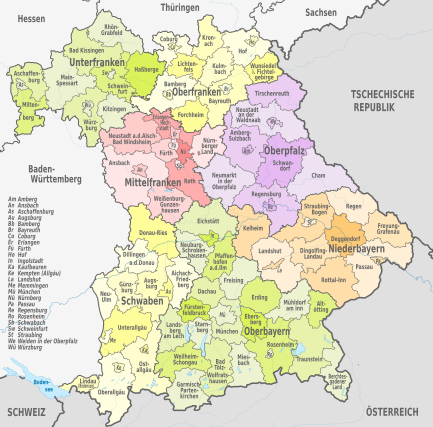
Map of the Landkreise of Bavaria
Rural districts:
Independent cities:
Municipalities [edit]
The 71 rural districts are on the lowest level divided into 2,031 regular municipalities (called Gemeinden , singular Gemeinde ). Together with the 25 independent cities ( kreisfreie Städte , which are in effect municipalities independent of Landkreis administrations), there are a total of 2,056 municipalities in Bavaria.


In 44 of the 71 rural districts, there are a full of 215 unincorporated areas (as of 1 Jan 2005, called gemeindefreie Gebiete , singular gemeindefreies Gebiet ), non belonging to any municipality, all uninhabited, generally forested areas, but also four lakes ( Chiemsee -without islands, Starnberger Encounter -without island Roseninsel , Ammersee , which are the three largest lakes of Bavaria, and Waginger Come across ).
Major cities and towns [edit]
| City | Region | Inhabitants (2000) | Inhabitants (2005) | Inhabitants (2010) | Inhabitants (2015) | Change (%) |
|---|---|---|---|---|---|---|
| Munich | Upper Bavaria | 1,210,223 | 1,259,677 | 1,353,186 | 1,450,381 | +11.81 |
| Nuremberg | Centre Franconia | 488,400 | 499,237 | 505,664 | 509,975 | +3.53 |
| Augsburg | Swabia | 254,982 | 262,676 | 264,708 | 286,374 | +3.81 |
| Regensburg | Upper Palatinate | 125,676 | 129,859 | 135,520 | 145,465 | +7.83 |
| Ingolstadt | Upper Bavaria | 115,722 | 121,314 | 125,088 | 132,438 | +8.09 |
| Würzburg | Lower Franconia | 127,966 | 133,906 | 133,799 | 124,873 | +4.56 |
| Fürth | Centre Franconia | 110,477 | 113,422 | 114,628 | 124,171 | +3.76 |
| Erlangen | Middle Franconia | 100,778 | 103,197 | 105,629 | 108,336 | +four.81 |
| Bayreuth | Upper Franconia | 74,153 | 73,997 | 72,683 | 72,148 | −1.98 |
| Bamberg | Upper Franconia | 69,036 | 70,081 | 70,004 | 73,331 | +one.40 |
| Aschaffenburg | Lower Franconia | 67,592 | 68,642 | 68,678 | 68,986 | +1.61 |
| Landshut | Lower Bavaria | 58,746 | 61,368 | 63,258 | 69,211 | +vii.68 |
| Kempten | Swabia | 61,389 | 61,360 | 62,060 | 66,947 | +1.09 |
| Rosenheim | Upper Bavaria | 58,908 | 60,226 | 61,299 | 61,844 | +four.06 |
| Neu-Ulm | Swabia | fifty,188 | 51,410 | 53,504 | 57,237 | +half dozen.61 |
| Schweinfurt | Lower Franconia | 54,325 | 54,273 | 53,415 | 51,969 | −1.68 |
| Passau | Lower Bavaria | fifty,536 | 50,651 | 50,594 | 50,566 | +0.11 |
| Freising | Upper Bavaria | 40,890 | 42,854 | 45,223 | 46,963 | +10.60 |
| Straubing | Lower Bavaria | 44,014 | 44,633 | 44,450 | 46,806 | +0.99 |
| Dachau | Upper Bavaria | 38,398 | 39,922 | 42,954 | 46,705 | +11.87 |
Source: Bayerisches Landesamt für Statistik und Datenverarbeitung[27] [28]
Politics [edit]

Bavaria has a multiparty system dominated by the conservative Christian Social Wedlock (CSU), which has won every election since 1945 with the exception of the 1950 ballot. Other important parties are The Greens, which became the second biggest party in the 2018 local parliament elections and the center-left Social Democrats (SPD), who have dominated the city of Munich until 2020. Hitherto, Wilhelm Hoegner has been the merely SPD candidate to ever become Government minister-President; notable successors in office include multi-term Federal Government minister Franz Josef Strauss, a central figure among West German conservatives during the Cold State of war years, and Edmund Stoiber, who both failed with their bids for Chancellorship.
The German Greens and the middle-correct Costless Voters have been represented in the land parliament since 1986 and 2008 respectively.
In the 2003 elections the CSU won a ⅔ supermajority – something no party had ever accomplished in postwar Germany. However, in the subsequent 2008 elections the CSU lost the absolute majority for the first time in 46 years.[29]
The losses were partly attributed by some to the CSU's opinion for an anti-smoking beak.[ further caption needed ] (A first anti-smoking law had been proposed by the CSU and passed only was watered downwardly after the election, afterwards which a referendum enforced a strict antismoking bill with a large majority).
Current Landtag [edit]

Current composition of the Landtag:
SPD: 22 seats
FDP: eleven seats
CSU: 85 seats
AfD: 22 seats
The last land elections were held on 14 Oct 2018 in which the CSU lost its accented majority in the land parliament in part due to the political party's stances as part of the federal government, winning 37.2% of the vote; the party's second worst local election outcome in its history after 1950. The Greens who had surged in the polls leading upwards to the election have replaced the social-democratic SPD every bit the 2d biggest force in the Landtag with 17.6% of the vote. The SPD lost over half of its previous share compared to 2013 with a mere nine.7% in 2018. The liberals of the FDP were again able to accomplish the five-percent-threshold in order to receive mandates in parliament afterward they were non part of the Landtag after the 2013 elections. Also inbound the new parliament were the right-wing populist Alternative for Frg (AfD), with 10.2% of the vote.[30]
The center-right Gratuitous Voters party gained eleven.6% of the vote and formed a government coalition with the CSU which led to the subsequent reelection of Markus Söder as Government minister-President of Bavaria.[ commendation needed ]
Government [edit]
- Bavarian Cabinet since 12 November 2018
The Constitution of Bavaria of the Free State of Bavaria was enacted on 8 December 1946. The new Bavarian Constitution became the footing for the Bavarian State afterward the Second World War.
Bavaria has a unicameral Landtag (English language: Country Parliament), elected by universal suffrage. Until December 1999, there was also a Senat , or Senate, whose members were chosen by social and economic groups in Bavaria, but following a referendum in 1998, this institution was abolished.[ citation needed ]
The Bavarian State Authorities consists of the Government minister-President of Bavaria, xi Ministers and six Secretaries of State. The Minister-President is elected for a menses of five years by the State Parliament and is caput of land. With the approval of the State Parliament he appoints the members of the State Authorities. The Land Government is composed of the:
- State Chancellery ( Staatskanzlei )
- Ministry of the Interior, for Sport and Integration ( Staatsministerium des Innern, für Sport und Integration )
- Ministry building for Housing, Construction and Ship ( Staatsministerium für Wohnen, Bau und Verkehr )
- Ministry of Justice ( Staatsministerium der Justiz )
- Ministry for Education and Civilization ( Staatsministerium für Bildung und Kultus )
- Ministry for Science and Art ( Staatsministerium für Wissenschaft und Kunst )
- Ministry building of Finance and for Dwelling house Affairs ( Staatsministerium der Finanzen und für Heimat )
- Ministry for Economic Affairs, Regional Evolution and Energy ( Staatsministerium für Wirtschaft, Landesentwicklung und Energie )
- Ministry for Environment and Consumer Protection ( Staatsministerium für Umwelt und Verbraucherschutz )
- Ministry building for Food, Agriculture and Forestry ( Staatsministerium für Ernährung, Landwirtschaft und Forsten )
- Ministry for Family unit, Labour and Social Affairs ( Staatsministerium für Familie, Arbeit und Soziales )
- Ministry building for Health and Care ( Staatsministerium für Gesundheit und Pflege )
- Ministry building for Digital Affairs ( Staatsministerium für Digitales )[31]
Political processes also take place in the seven regions ( Regierungsbezirke or Bezirke ) in Bavaria, in the 71 rural districts ( Landkreise ) and the 25 towns and cities forming their ain districts ( kreisfreie Städte ), and in the 2,031 local authorities ( Gemeinden ).
In 1995 Bavaria introduced directly democracy on the local level in a referendum. This was initiated bottom-upwardly by an association chosen Mehr Demokratie (English language: More Democracy). This is a grass-roots organization which campaigns for the right to citizen-initiated referendums. In 1997 the Bavarian Supreme Court tightened the regulations considerably (including by introducing a turn-out quorum). Nevertheless, Bavaria has the most advanced regulations on local straight commonwealth in Germany. This has led to a spirited citizens' participation in communal and municipal affairs—835 referenda took place from 1995 through 2005.
Government minister-presidents of Bavaria since 1945 [edit]
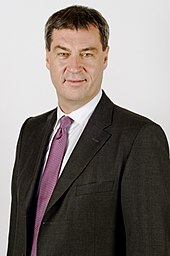
| Ministers-President of Bavaria | |||||
|---|---|---|---|---|---|
| No. | Proper noun | Built-in and died | Party amalgamation | Begin of tenure | Finish of tenure |
| 1 | Fritz Schäffer | 1888–1967 | CSU | 1945 | 1945 |
| 2 | Wilhelm Hoegner | 1887–1980 | SPD | 1945 | 1946 |
| iii | Hans Ehard | 1887–1980 | CSU | 1946 | 1954 |
| four | Wilhelm Hoegner | 1887–1980 | SPD | 1954 | 1957 |
| v | Hanns Seidel | 1901–1961 | CSU | 1957 | 1960 |
| six | Hans Ehard | 1887–1980 | CSU | 1960 | 1962 |
| 7 | Alfons Goppel | 1905–1991 | CSU | 1962 | 1978 |
| 8 | Franz Josef Strauß | 1915–1988 | CSU | 1978 | 1988 |
| 9 | Max Streibl | 1932–1998 | CSU | 1988 | 1993 |
| 10 | Edmund Stoiber | *1941 | CSU | 1993 | 2007 |
| 11 | Günther Beckstein | *1943 | CSU | 2007 | 2008 |
| 12 | Horst Seehofer | *1949 | CSU | 2008 | 2018 |
| 13 | Markus Söder | *1967 | CSU | 2018 | Incumbent |
Designation every bit a "gratis state" [edit]
Unlike most High german states (Länder), which merely designate themselves as "State of" (Land [...]), Bavaria uses the style of "Free State of Bavaria" (Freistaat Bayern). The difference from other states is purely terminological, as German ramble law does non draw a stardom betwixt "States" and "Free States". The state of affairs is thus analogous to the United states, where some states use the style "Republic" rather than "Land". The term "Free State", a creation of the 19th century and intended to exist a German alternative to (or translation of) the Latin-derived commonwealth was mutual amidst the states of the Weimar Democracy, afterwards German monarchies had been abolished. Dissimilar almost other states - many of which were new creations - Bavaria has resumed this terminology after World War II. 2 other states, Saxony and Thuringia, also telephone call themselves "Free State".
Arbitrary abort and human rights [edit]
In July 2017, Bavaria's parliament enacted a new revision of the "Gefährdergesetz", allowing the government to imprison a person for a three months term, renewable indefinitely, when they haven't committed a crime but information technology is assumed that they might commit a crime "in the near future".[32] Critics similar the prominent announcer Heribert Prantl have called the law "shameful" and compared it to Guantanamo Bay detention camp,[33] assessed it to be in violation of the European Convention on Human Rights,[34] and also compared information technology to the legal situation in Russia, where a similar law allows for imprisonment for a maximum term of two years (i.eastward., not indefinitely).[35]
Economic system [edit]

Bavaria has long had one of the largest economies of whatsoever region in Germany, and in Europe.[36] Its gross domestic product (GDP) in 2007 exceeded €434 billion (about U.S. $600 billion).[37] This makes Bavaria itself 1 of the largest economies in Europe, and but twenty countries in the world have a college Gdp.[38] The Gdp of the region increased to €617.ane billion in 2018, accounting for 18.5% of High german economic output. Gdp per capita adjusted for purchasing ability was €43,500 or 145% of the EU27 average in the same year. The GDP per employee was 114% of the European union average. This makes Bavaria one of the wealthiest regions in Europe.[39] Bavaria has potent economic ties with Republic of austria, Czechia, Switzerland, and Northern Italy.[twoscore] In 2019 Gross domestic product was €832.four ($905.7) billion, €48,323 ($52,577.3) per capita.[41]
Agronomics [edit]
The almost distinctive high points of Bavarian agriculture are:
- Hop growing in region Hallertau, which is up to fourscore% of German language production and exported worldwide.
- Inland aquaculture of carps and trout.
- The well-hydrated alpine meadows are used to produce large quantities of quality milk, which is used to brand a variety of cheese (including bluish-veined cheese), yogurt and butter (Meggle).
- The cultivation of asparagus is widespread, which is a very popular new flavour vegetable. In season ("Spargelzeit") restaurants offering special separated aspargaus menu . There is an asparagus museum in Schrobenhausen.
- In that location are farms producing venison from deer and roe.
- Viticulture is widespread in Lower Franconia.
- Good ecology and strict control allow produce a large amount of organic products ("bio") and babe food.
-

Hop garten
-

Allgäuer meadows
-
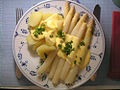
Asparagus with sauce hollandaise
-
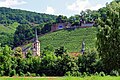
Vineyards in Klingenberg-am-Master
Industries [edit]
Bavaria has the best developed industry in Germany[42] and the lowest unemployment charge per unit with 2.9% as of October 2021.[43]
Branches:
- Oil refining. Although there is oil product in Bavaria, it does non meet domestic needs. Virtually of the oil is imported via pipelines from the Czechia (Russian oil) and from the Italian port of Trieste (Near Eastward oil). Three refineries are situated near Ingolstadt and another one in Burghausen. Last i is a part of Bavarian chemical triangle and delivery row materials to other chemical plants.
-

Refinery Ingolstadt
-

transalpine pipeline
- Automotive is the well-nigh of import and best developed Bavarian industry, which included manufacture of luxury cars (4 BMW and 2 Audi plants, R&D centers, test tracks), trucks (Traton Human), special vehicles (Tadano Faun), buses (Evobus/Setra) and automotive parts (engines, electronics, cables, seats, interiors, cabrio roofs, heating and brake systems, software). Bavaria has the second-near employees (207,829) in the automotive industry of all German language states later on Baden-Württemberg equally of 2018.[44]
-

BMW 7 Series
-

Audi A5
-

MAN TGX
-

Faun HK 100
-
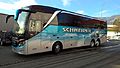
Setra S515HDH
- Aerospace and defense, which manufacture multi-role attack jet Eurofighter Draft, missiles from MBDA and Diehl Defence, parts of rocket Ariane, regional jet Dornier 728, ultra-light planes from Grob Aerospace, turbo jet engines for civil and armed services applications from MTU Aero Engines, helicopters Airbus, primary battle tank Leopard 2, drones, composite parts, avionics, radars, propellants, initiators, powder, munitions. In Munich suburban Oberpfaffenhofen situated control center of European satellite navigation arrangement Galileo, German language Infinite Operations Heart, Microwaves and Radar Found, Institute of Communications and Navigation, Remote Sensing Engineering Plant, Institute of Atmospheric Physics, Found of Robotics and Mechatronics, Institute for Software Engineering, Found of System Dynamics and Command.
-
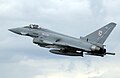
Eurofighter Typhoon
-

Grob G 120TP
-

Airbus EC-665 Tiger
-
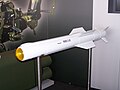
PARS 3 LR
-

Leopard 2
- Other send manufacturing too represents in Bavaria. Even exists ship yards, for example Bavaria Yachtbau, despite location many hundreds kilometers from body of water abroad; manufacturing of 4-stroke marine diesel engine, which using in cruise liners, ferries and warships. Rails technique produce in Munich-Allach (locomotive Siemens Vectron) and track maintenance vehicle in Freilassing.
-

Bavaria R40
-

MAN marine diesel fuel
-

Siemens Vectron
-

Robel BR 711.2
- Electronics. Bit design centers situated in Munich area (Infineon, Intel, Apple tree). There are 3 FABs: Infineon in Regensburg, Texas Instruments in Freising and Osram Optosemiconductors besides in Regensburg. Power semiconductors are manufactured past Semikron. CNC controls are produced by Heidenhain, Traunreut and Siemens, Amberg. Silicon wafer for electronic manufacturing are delivered from Siltronic plant in Burghausen.
-

Campeon - Infineon and Intel R&D centers
-

CNC controls Heidehain iTNC 530
-

Programmable logic controller Siemens Simatic S7-1500
-
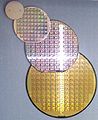
Silicon wafers
- Medical equipment. In Erlangen is a headquarters of Siemens Healthineers which produce devices for figurer tomography, interventional X-ray systems, radiations therapy, molecular and magnetic resonance imaging, software. Brainlab creates software and hardware for image-guided surgery. Roche Diagnostics in Penzberg manufactures therapeutic proteins, diagnostic tests, reagents, analyze system and biopharma products.
-

Siemens E.Cam Duet
- Brewery. Bavaria has long tradition of brewery, near a half of all German breweries are located here (645 of 1300). All possible types of breweries exist: home brewery of hotel or restaurant, belong to big international concern, state-owned, castle or monastery breweries. The perfect quality of beer is guaranteed by 500-years law ("Reinheitsgebot"), which permit every bit beer ingredients only h2o, hops, yeast and malt of barley, wheat or rye. Merely difference of roasting, fermentation or mixing allow to produce many different types of beers (not brand). Vladimir Putin at 2009 tasted beer from Brauerei Aying, Barack Obama at 2015 also tasted Bavarian beer of Karg Brauerei in Murnau. In Freising situated inquiry center Weihenstephan for brewing and nutrient quality.
-

Brauerei Aying
-
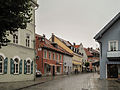
Murnau am Staffelsee
-

Cold reservoirs
-
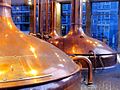
Tanks
Companies [edit]
Many big companies are headquartered in Bavaria, including Adidas, Allianz, Airbus, Audi, BMW, Brose, BSH Hausgeräte, HypoVereinsbank, Infineon, KUKA, Traton, MTU Aero Engines, Munich Re, Osram, Puma, Rohde & Schwarz, Schaeffler, Siemens, Wacker Chemie, Linde, Vitesco Technologies, Webasto, Grob, Heidenhain, Koenig & Bauer, Kaeser Compressors, Krones, Knorr-Bremse, Wacker Neuson, Krauss-Maffei Wegmann, Siltronic, Leoni, Fielmann, MediaMarkt, Conrad Electronic, BayWa, ProSiebenSat.1 Media, Telefónica Germany, Knauf, Rehau, Giesecke+Devrient.
Also American companies open a lot of research and development centers in Munich region: Apple (chip design), Google (information security), IBM (Watson technology), Intel (drones and telecommunications chips), Full general Electric (3D-printers and additive manufacturing), Gleason (gears manufacturing), Texas Instruments (fleck design and manufacturing), Coherent (lasers).

Tourism [edit]
With 40 meg tourists in 2019, Bavaria is the most visited German language state and 1 of Europe's leading tourist destinations.[45]
Attractions:
- Entertainment parks: Legoland in Günzburg, Bayern-Park in Reisbach (Vils), Playmobil in Zirndorf, Skyline Park in Bad Wörishofen and Bavaria Filmstadt in Grünwald
- Christmas markets in Rothenburg ob der Tauber, Nuremberg and Munich
- Factory-Outlet-Centers: Ingolstadt Village and Wertheim Hamlet
- Festivals: Oktoberfest
Unemployment [edit]
The unemployment charge per unit stood at 2.6% in October 2018, the lowest in Germany and one of the lowest in the European union.[46]
| Year[47] | 2000 | 2001 | 2002 | 2003 | 2004 | 2005 | 2006 | 2007 | 2008 | 2009 | 2010 | 2011 | 2012 | 2013 | 2014 | 2015 | 2016 | 2017 | 2018 |
|---|---|---|---|---|---|---|---|---|---|---|---|---|---|---|---|---|---|---|---|
| Unemployment rate in % | 5.v | five.3 | 6.0 | 6.nine | half dozen.9 | 7.viii | 6.viii | v.3 | four.2 | 4.viii | 4.5 | 3.8 | three.7 | 3.8 | 3.8 | 3.6 | iii.5 | 3.ii | two.9 |
Demographics [edit]

Bavaria is i of Germany's least densely populated states.
Bavaria has a population of approximately 13.ane meg inhabitants (2020). eight of the 80 largest cities in Frg are located within Bavaria with Munich being the largest (1,484,226 inhabitants, approximately vi.i million when including the broader metropolitan area), followed past Nuremberg (518,370 inhabitants, approximately 3.6 meg when including the broader metropolitan surface area), Augsburg (296,582 inhabitants) and Regensburg (153,094 inhabitants). All other cities in Bavaria had less than 150,000 inhabitants each in 2020. Population density in Bavaria was 186/km2 (480/sq mi), below the national average of 233/km2 (600/sq mi). Foreign nationals resident in Bavaria (both immigrants and refugees/asylum seekers) were principally from other EU countries and Turkey.
| Tiptop-ten foreign resident populations [48] | ||
| Nationality | Population (31 December 2020) | |
|---|---|---|
| 1 |  Romania Romania | 191,410 |
| 2 |  Turkey Turkey | 190,730 |
| iii |  Republic of croatia Republic of croatia | 126,090 |
| 4 |  Poland Poland | 116,320 |
| 5 |  Italy Italy | 105,930 |
| 6 |  Austria Austria | 85,050 |
| 7 |  Syria Syria | 77,445 |
| viii |  Greece Greece | 76,875 |
| ix |  Republic of hungary Republic of hungary | 75,705 |
| 10 |  Bosnia and Herzegovina Bosnia and Herzegovina | threescore,415 |
Vital statistics [edit]
| Comparison period | Births | Deaths | Natural growth |
|---|---|---|---|
| January – November 2016 |  115,032 115,032 |  116,915 116,915 | -i,883 |
| January – November 2017 | 115,690 |  122,247 122,247 |  -6,557 -6,557 |
Culture [edit]
Some features of the Bavarian civilisation and mentality are remarkably singled-out from the residual of Deutschland. Noteworthy differences (particularly in rural areas, less significant in the major cities) tin can be found with respect to religion, traditions, and linguistic communication.
Religion [edit]

A Cosmic church building most Füssen with the Alps in the background
Bavarian culture (Altbayern) has a long and predominant tradition of Roman Catholic faith. Pope emeritus Benedict XVI (Joseph Alois Ratzinger) was built-in in Marktl am Inn in Upper Bavaria and was Cardinal-Archbishop of Munich and Freising. Otherwise, the culturally Franconian and Swabian regions of the modern State of Bavaria are historically more diverse in religiosity, with both Catholic and Protestant traditions. In 1925, seventy.0% of the Bavarian population was Catholic, 28.viii% was Protestant, 0.7% was Jewish, and 0.five% was placed in other religious categories.[51]
As of 2020[update] 46.9% of Bavarians adhered to Catholicism (a decline from 70.4% in 1970).[52] [l] 17.2 percent of the population adheres to the Evangelical Lutheran Church in Bavaria, which has also declined since 1970.[52] [50] Three percent was Orthodox, Muslims make upwards iv.0% of the population of Bavaria. 31.9 percent of Bavarians are irreligious or adhere to other religions.
Traditions [edit]
Bavarians usually emphasize pride in their traditions. Traditional costumes collectively known as Tracht are worn on special occasions and include in Altbayern Lederhosen for males and Dirndl for females. Centuries-onetime folk music is performed. The Maibaum, or Maypole (which in the Middle Ages served as the customs's business concern directory, as figures on the pole represented the trades of the hamlet), and the bagpipes of the Upper Palatinate region prove to the ancient Celtic and Germanic remnants of cultural heritage of the region. There are many traditional Bavarian sports disciplines, e.g. the Aperschnalzen, competitive whipcracking.
Whether actually in Bavaria, overseas or with citizens from other nations Bavarians continue to cultivate their traditions. They concord festivals and dances to keep their heritage live. In New York City the German American Cultural Society is a larger umbrella group for others which stand for a specific function of Deutschland, including the Bavarian organizations. They present a German parade called Steuben Parade each yr. Various affiliated events take place amongst its groups, one of which is the Bavarian Dancers.
Food and drink [edit]
Bavarians tend to place a great value on food and potable. In add-on to their renowned dishes, Bavarians also consume many items of food and drink which are unusual elsewhere in Frg; for case Weißwurst ("white sausage") or in some instances a diverseness of entrails. At folk festivals and in many beer gardens, beer is traditionally served by the litre (in a Maß ). Bavarians are particularly proud[ citation needed ] of the traditional Reinheitsgebot , or beer purity police force, initially established by the Duke of Bavaria for the City of Munich (i.due east. the court) in 1487 and the duchy in 1516. According to this law, only three ingredients were allowed in beer: water, barley, and hops. In 1906 the Reinheitsgebot fabricated its manner to all-German language law, and remained a law in Germany until the Eu partly struck it down in 1987 as incompatible with the European common market.[53] High german breweries, however, cling to the principle, and Bavarian breweries still comply with it in order to distinguish their beer brands.[54] Bavarians are too known equally some of the world's virtually prolific beer drinkers, with an average annual consumption of 170 liters per person.[ citation needed ]
Bavaria is also home to the Franconia wine region, which is situated forth the river Main in Franconia. The region has produced wine (Frankenwein) for over 1,000 years and is famous for its utilise of the Bocksbeutel vino bottle. The production of wine forms an integral office of the regional culture, and many of its villages and cities hold their own wine festivals (Weinfeste) throughout the yr.
-

Schweinsbraten
-

Nürnberger Rostbratwürste
Language and dialects [edit]
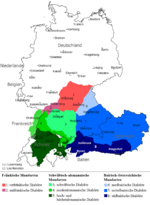
Upper German and the southern counterpart to Central German language both form the High High german languages, while the Austro-Bavarian dialects are in bluish
Three German dialects are near ordinarily spoken in Bavaria: Austro-Bavarian in Old Bavaria (Upper Bavaria, Lower Bavaria and the Upper Palatinate), Swabian High german (an Alemannic German dialect) in the Bavarian part of Swabia (s due west) and East Franconian German language in Franconia (North). In the small town Ludwigsstadt in the n, commune Kronach in Upper Franconia, Thuringian dialect is spoken. During the 20th century an increasing office of the population began to speak Standard High german (Hochdeutsch), mainly in the cities.
Ethnography [edit]
Bavarians consider themselves to be egalitarian and breezy.[55] Their sociability can be experienced at the almanac Oktoberfest, the world's largest beer festival, which welcomes around vi million visitors every year, or in the famous beer gardens. In traditional Bavarian beer gardens, patrons may bring their ain food but buy beer only from the brewery that runs the beer garden.[56]
In the United states of america, peculiarly among German Americans, Bavarian culture is viewed somewhat nostalgically, and several "Bavarian villages" accept been founded, virtually notably Frankenmuth, Michigan; Helen, Georgia; and Leavenworth, Washington. Since 1962, the latter has been styled with a Bavarian theme and is home to an Oktoberfest commemoration it claims is amidst the most attended in the world exterior of Munich.[57]
Sports [edit]
Football [edit]

The Allianz Arena, 1 of the earth'south most famous football stadiums
Bavaria is habitation to several football clubs including FC Bayern Munich, 1. FC Nürnberg, FC Augsburg, TSV 1860 Munich, FC Ingolstadt 04 and SpVgg Greuther Fürth. Bayern Munich is the near successful football team in Germany having won a record 30 High german titles and 6 UEFA Champions League titles. They are followed by 1. FC Nürnberg who take won ix titles. SpVgg Greuther Fürth accept won 3 championships while TSV 1860 Munich accept been champions once.
Basketball [edit]
Bavaria is also abode to several professional person basketball teams, including FC Bayern Munich, Brose Baskets Bamberg, s.Oliver Würzburg, Nürnberg Falcons BC and TSV Oberhaching Torrid zone.
Ice hockey [edit]
There are five Bavarian ice hockey teams playing in the German top-tier league DEL: EHC Ruby Bull München, Nürnberg Ice Tigers, Augsburger Panther, ERC Ingolstadt, and Straubing Tigers.
Notable people [edit]
Many famous people have been born or lived in nowadays-day Bavaria:
- Kings: Arnulf of Carinthia, Carloman of Bavaria, Charles the Fatty, Lothair I, Louis the Child, Louis the German, Louis the Younger, Ludwig I of Bavaria, Ludwig Two of Bavaria, Ludwig 3 of Bavaria, Maximilian I Joseph of Bavaria, Maximilian Two of Bavaria, Otto, King of Bavaria
- Religious leaders: Pope Benedict 16 (Joseph Aloisius Ratzinger); Pope Damasus II, Pope Victor II.
- Painters: Albrecht Dürer, Albrecht Altdorfer, Carl Spitzweg, Erwin Eisch, Franz von Lenbach, Franz von Stuck, Franz Marc, Gabriele Münter, Hans Holbein the Elder, Johann Christian Reinhart, Lucas Cranach, Paul Klee.
- Classical musicians Orlando di Lasso, Christoph Willibald Gluck, Leopold Mozart, Max Reger, Richard Wagner, Richard Strauss, Carl Orff, Johann Pachelbel, Theobald Boehm, Klaus Nomi.
- Other musicians Hans-Jürgen Buchner, Barbara Dennerlein, Klaus Doldinger, Franzl Lang, Bands: Spider Murphy Gang, Sportfreunde Stiller, Obscura, Michael Bredl
- Opera singers Jonas Kaufmann, Diana Damrau.
- Writers, poets and playwrights Hans Sachs, Jean Paul, Friedrich Rückert, August von Platen-Hallermünde, Frank Wedekind, Christian Morgenstern, Oskar Maria Graf, Bertolt Brecht, Lion Feuchtwanger, Thomas Mann, Klaus Isle of man, Golo Mann, Ludwig Thoma, Michael Ende, Ludwig Aurbacher.
- Scientists Albert Einstein, Max Planck, Wilhelm Conrad Röntgen, Werner Heisenberg, Adam Ries, Joseph von Fraunhofer, Georg Ohm, Johannes Stark, Carl von Linde, Ludwig Prandtl, Rudolf Mössbauer, Lothar Rohde, Hermann Schwarz, Robert Huber, Martin Behaim, Levi Strauss, Rudolf Diesel.
- Physicians Alois Alzheimer, Max Joseph von Pettenkofer, Sebastian Kneipp.
- Politicians Ludwig Erhard, Horst Seehofer, Christian Ude, Kurt Eisner, Franz-Josef Strauß, Roman Herzog, Leonard John Rose, Henry Kissinger.
- Football game players Max Morlock, Karl Mai, Franz Beckenbauer, Sepp Maier, Gerd Müller, Paul Breitner, Bernd Schuster, Klaus Augenthaler, Lothar Matthäus, Philipp Lahm, Bastian Schweinsteiger, Holger Badstuber, Thomas Müller, Mario Götze, Dietmar Hamann, Stefan Reuter
- Other sportspeople Bernhard Langer, Dirk Nowitzki
- Actors Michael Herbig, Werner Stocker, Helmut Fischer, Walter Sedlmayr, Gustl Bayrhammer, Ottfried Fischer, Ruth Drexel, Elmar Wepper, Fritz Wepper, Uschi Glas, Yank Azman.
- Entertainers Siegfried Fischbacher
- Film directors Helmut Dietl, Rainer Werner Fassbinder, Bernd Eichinger, Joseph Vilsmaier, Hans Steinhoff, Heinz Badewitz and Werner Herzog.
- Designers Peter Schreyer, Damir Doma
- Entrepreneurs Charles Diebold, Levi Strauss
- War machine Claus von Stauffenberg
- Nazis: Sepp Dietrich, Karl Fiehler, Karl Gebhardt, Hermann Göring, Heinrich Himmler, Alfred Jodl, Josef Kollmer, Joseph Mengele, Ernst Röhm, Franz Ritter von Epp, Julius Streicher
- Others: Kaspar Hauser, The Smith of Kochel, Mathias Kneißl, Matthias Klostermayr, Anneliese Michel
See also [edit]
- Outline of Deutschland
- Erstwhile countries in Europe later 1815
- Listing of Bavaria-related topics
- List of Premiers of Bavaria
- List of rulers of Bavaria
Notes [edit]
References [edit]
- ^ "GDP NRW official statistics". Archived from the original on 25 June 2020. Retrieved 17 Feb 2019.
- ^ "Sub-national HDI - Area Database - Global Information Lab". hdi.globaldatalab.org. Archived from the original on 23 September 2018. Retrieved thirteen September 2018.
- ^ "Bavaria". Lonely Planet. Archived from the original on 7 September 2015. Retrieved 31 August 2015.
- ^ "Bavaria". Britannica. Archived from the original on 5 September 2015. Retrieved 31 August 2015.
- ^ "Kirchenmitgliederzahlen Stand 31.12 2016" (PDF). ekd.de. Archived from the original (PDF) on 12 April 2018. Retrieved 25 April 2018.
- ^ Local, The (iv February 2010). "Bavaria – The Local". The Local. Archived from the original on 22 Dec 2015. Retrieved 31 Baronial 2015.
- ^ Campbell, Eric (14 Feb 2012). "Germany – A Bavarian Fairy Tale". ABC. Archived from the original on 27 August 2015. Retrieved 31 August 2015.
- ^ Dovid Solomon Ganz, Tzemach Dovid (tertiary edition), part 2, Warsaw 1878, pp. 71, 85 (online Archived 14 April 2016 at the Wayback Car )
- ^ Dark-brown, Warren (2001). Unjust Seizure (1st ed.). p. 63. ISBN9780801437908. Archived from the original on twenty May 2021. Retrieved 31 Baronial 2015.
- ^ "History of Bavaria". Guide to Bavaria. Archived from the original on half dozen September 2015. Retrieved 31 August 2015.
- ^ Frassetto, Michael (2013). The Early Medieval Earth: From the Autumn of Rome to the Fourth dimension of Charlemagne [2 Volumes]. ABC-CLIO. p. 145. ISBN978-1598849967. Archived from the original on xx May 2021. Retrieved 13 August 2020.
- ^ Collins, Roger (2010). Early Medieval Europe, 300–chiliad. Palgrave Macmillan. p. 273. ISBN978-1137014283. Archived from the original on 17 March 2016. Retrieved xix September 2017.
- ^ Harrington, Joel F. (1995). Reordering Marriage and Order in Reformation Germany. Cambridge: Cambridge Academy Press. p. 17. ISBN978-0521464833. Archived from the original on 20 May 2021. Retrieved thirteen August 2020.
- ^ Hanson, Paul R. (2015). Historical Dictionary of the French Revolution (ii ed.). Rowman & Littlefield. ISBN978-0810878921.
bavaria kingdom 1806 napoleon.
- ^ Sheehan, James J. (1993). High german History, 1770–1866. Clarendon Press. p. 265. ISBN978-0198204329. Archived from the original on 20 May 2021. Retrieved 13 Baronial 2020.
- ^ Minahan, James (2000). One Europe, Many Nations: A Historical Dictionary of European National Groups. Greenwood Publishing Grouping. pp. 106–. ISBN978-0-313-30984-7. Archived from the original on 30 September 2015. Retrieved 13 August 2015.
- ^ William L. Shirer, The Rise and Fall of the Tertiary Reich: A History of Nazi Germany, New York, NY, Simon & Schuster, 2011, p. 33
- ^ Karacs, Imre (13 July 1996). "Bavaria buries the purple dream Funeral of Prince Albrechty". The Independent. Archived from the original on 12 April 2019. Retrieved 19 September 2017.
- ^ "Gratuitous State of Bavaria (Freistaat Bayern) - Historisches Lexikon Bayerns". www.historisches-lexikon-bayerns.de. Archived from the original on 14 May 2021. Retrieved xi April 2021.
- ^ Bavaria Guide Archived four Feb 2013 at the Wayback Machine. European-holiday-planner.com; retrieved 16 July 2013.
- ^ Lunau, Kate. (25 June 2009) "No more than Bavarian separatism – World" Archived 4 Jan 2014 at the Wayback Car , Macleans.ca, 25 June 2009; retrieved 16 July 2013.
- ^ "Flag Legislation (Bavaria, Germany), Executive Order on Flags of 1954". Flags of the World. Archived from the original on xi March 2016. Retrieved 19 September 2011.
- ^ a b c d Sebald, Christian. "Bayern: So sieht das Klima der Zukunft aus". Süddeutsche.de. Archived from the original on iii August 2020. Retrieved 22 April 2020.
- ^ Bayerischer Rundfunk, Klimawanddel-bayern-folgen-erwaermung-100.html
- ^ https://www.statistik.bayern.de/mam/produkte/veroffentlichungen/statistische_berichte/a1200c_201944.xla Archived 18 December 2020 at the Wayback Motorcar[ blank URL ]
- ^ Bayerisches Landesamt für Statistik, München 2015 (thirty Baronial 2015). "Bayerisches Landesamt für Statistik – GENESIS-Online Bayern". bayern.de. Archived from the original on 9 December 2012. Retrieved nine May 2014.
- ^ Bayerisches Landesamt für Statistik, München 2017 (23 April 2017). "Bayerisches Landesamt für Statistik – GENESIS-Online Bayern". bayern.de. Archived from the original on nine December 2012. Retrieved 9 May 2014.
- ^ "n-tv:Fiasko für die CSU". Archived from the original on 29 September 2008.
- ^ tagesschau.de. "tagesschau.de". wahl.tagesschau.de. Archived from the original on xv Oct 2018. Retrieved fifteen October 2018.
- ^ "Staatsministerien – Bayerisches Landesportal". Archived from the original on 17 Apr 2021. Retrieved 11 Apr 2021.
- ^ Gefährder-Gesetz verschärft Archived xx July 2017 at the Wayback Car, Süddeutsche Zeitung, xix July 2017
- ^ Bayern führt Unendlichkeitshaft ein Archived 21 July 2017 at the Wayback Car, Heribert Prantl, 20 July 2017
- ^ Reisewarnung für Bayern Archived 27 August 2017 at the Wayback Machine, Udo Vetter, 20 July 2017
- ^ Erinnert ihr euch noch daran, als Bayern als Rechtsstaat galt? Archived 22 July 2017 at the Wayback Machine, Felix von Leitner, 20 July 2017
- ^ Its Gross domestic product is 143% of the EU average (as of 2005[update]) whilst the High german average is 121.v%. Source: Eurostat [ permanent expressionless link ]
- ^ Statistisches Landesamt Baden-Württemberg. "Gemeinsames Datenangebot der Statistischen Ämter des Bundes und der Länder". baden-wuerttemberg.de. Archived from the original on 4 March 2008. Retrieved 22 February 2008.
- ^ Come across the list of countries past GDP.
- ^ "Regional Gdp per capita ranged from 30% to 263% of the EU average in 2018". Eurostat. Archived from the original on 17 April 2020. Retrieved 8 March 2020.
- ^ "Germany / Upper Bavaria – Business-Transfer". Archived from the original on 23 Feb 2018. Retrieved 23 February 2018.
- ^ "Federal States of Deutschland". Deutschland.de. 29 September 2020. Archived from the original on 19 Dec 2021. Retrieved 19 March 2022.
- ^ "Umsätze in der Industrie". Deutschland in Zahlen (in High german). Archived from the original on xx May 2021. Retrieved 3 April 2021.
- ^ "Arbeitslosenquote in Frg nach Bundesländern 2020". Statista (in German language). Archived from the original on 27 June 2021. Retrieved 1 January 2021.
- ^ Schäfer, Kristina Antonia. "Blick hinter dice Zahlen #five: Wo in Deutschland dice meisten Jobs an der Autobranche hängen". www.wiwo.de (in German). Archived from the original on 31 October 2020. Retrieved 27 March 2021.
- ^ "Daten & Fakten". Bavarian Ministry of Economic Affairs, Regional Development and Energy (in German). Archived from the original on 22 June 2020. Retrieved 11 June 2020.
- ^ "Arbeitslosenquote nach Bundesländern in Deutschland 2018 | Statista". Statista (in High german). Archived from the original on 27 June 2021. Retrieved xiii November 2018.
- ^ (Destatis) Statistisches Bundesamt (xiii November 2018). "Federal Statistical Function Deutschland – GENESIS-Online". world wide web-genesis.destatis.de. Archived from the original on 13 Nov 2018. Retrieved 13 Nov 2018.
- ^ "High german Statistical Office". Archived from the original on 12 Feb 2018. Retrieved 12 February 2018.
- ^ "Statistik Portal". Statische Ämter. Archived from the original on 25 December 2017. Retrieved 3 July 2018.
- ^ a b c "Kirchenmitgliederzahlen Stand up 31.12.2020" (PDF). ekd.de. Archived (PDF) from the original on 21 December 2021. Retrieved 13 January 2022.
- ^ Grundriss der Statistik. II. Gesellschaftsstatistik by Wilhelm Winkler, p. 36
- ^ a b Bayerischer Rundfunk. "Massive Kirchenaustritte: Das Ende der Kirche wie wir sie kennen – Religion – Themen – BR.de". br.de. Archived from the original on 22 July 2015.
- ^ "30.04.2005 – Eu-Recht". 30 April 2005. Archived from the original on 30 Apr 2005.
- ^ "To Bier or not to Bier? vom 22.10.2015: Das Reinheitsgebot und seine Tücken – BR Mediathek VIDEO". br.de. Archived from the original on 27 October 2015.
- ^ "Bavaria". Travel to Federal republic of germany. Travel to Germany. 24 August 2018. Archived from the original on 28 September 2020. Retrieved 29 September 2020.
- ^ Königlicher Hirschgarten. "Ein paar Worte zu unserem Biergarten in München ... (in German)". Archived from the original on 18 May 2012. Retrieved 12 Feb 2012.
- ^ "Leavenworth Washington Hotels, Lodging, Festivals & Events". Visit Leavenworth Washington, U.s.. Archived from the original on 5 September 2008. Retrieved 29 September 2007.
Sources [edit]
- . Encyclopædia Britannica. Vol. 3 (11th ed.). 1911.
External links [edit]
 | Wikimedia Commons has media related to Bavaria. |
 | Wikivoyage has a travel guide for Bavaria . |
- Official government website
- Official website of Bayern Tourismus Marketing GmbH
- Bavarian Studies in History and Culture
- Außenwirtschaftsportal Bayern
- Statistics
-
 Geographic data related to Bavaria at OpenStreetMap
snyderneverfunuty.blogspot.com
Source: https://en.wikipedia.org/wiki/Bavaria
0 Response to "Who Is Bavaria in Revolt Agains"
Enregistrer un commentaire